
Who is legally allowed to whiten your teeth — or treat your face?
Tooth whitening at a beauty salon is a criminal offence in this country. Most people have no idea — and the same confusion surrounds facial treatments, where the law is patchier than almost anyone assumes. Here is where the lines actually fall, and how to check anyone before you let them treat you.
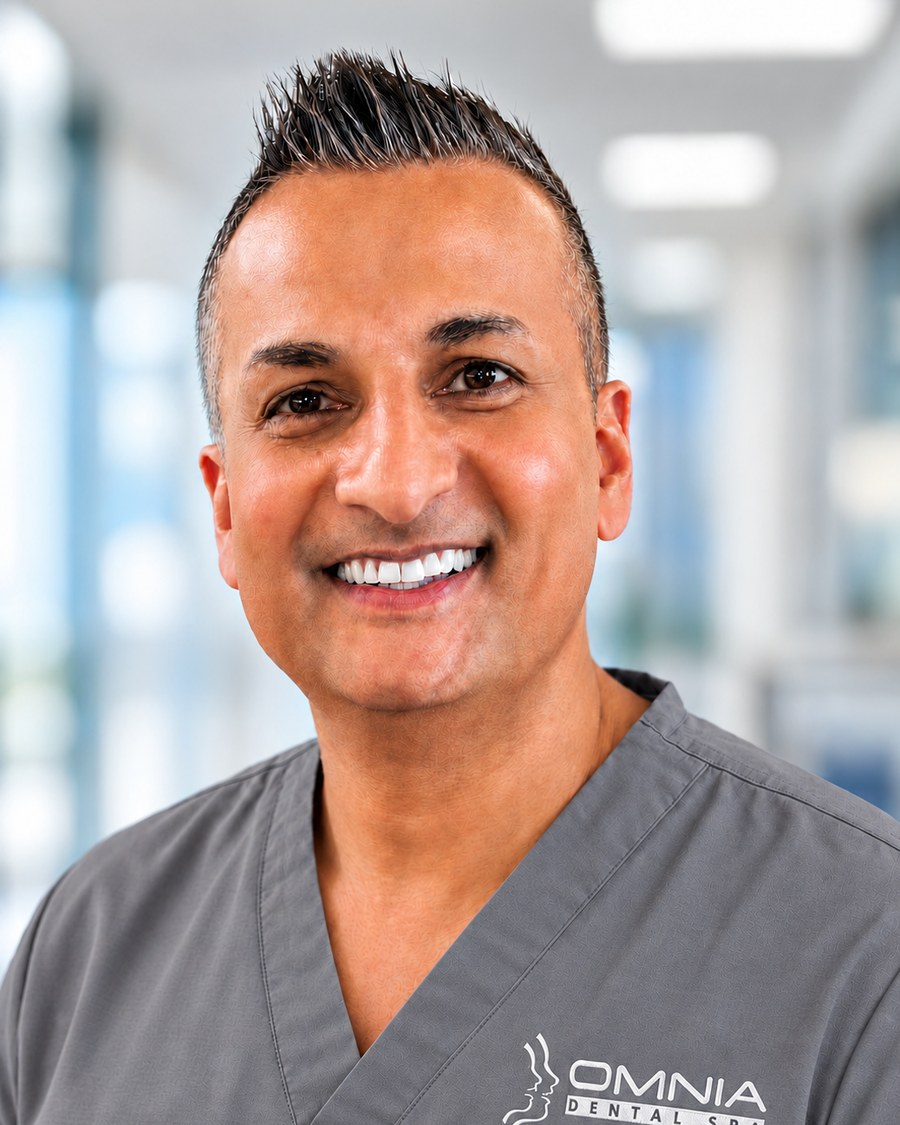 By Dr Tirj Gidda · Principal Dentist, Omnia Dental Spa
Updated October 2026 · 6 min read
Written by Dr Tirj Gidda, Principal Dentist at Omnia Dental SpaAdapted for Clear Braces SolihullOctober 2026
The short answer
Tooth whitening is dentistry. Under the Dentists Act 1984 it may only be carried out by a dentist, or by a hygienist, therapist or clinical dental technician working to a dentist’s prescription — and only after an examination. A beauty salon, a mobile technician or someone trained on a weekend course who offers whitening is committing a criminal offence, however impressive the certificate on the wall.
Facial treatments are a different legal picture, and a more complicated one. That difference is worth understanding before you book anything.

Why the law draws the line where it does
It isn’t professional protectionism. Whitening gel is a powerful chemical applied millimetres from your gums, nerves and any existing dental work. Before whitening anyone, a dentist checks for decay, leaking fillings, gum disease, cracks and exposed roots — because whitening a mouth with any of those can cause genuine harm.
A beauty therapist may be excellent at what they are trained to do. They are not trained to examine your mouth, cannot diagnose what they are looking at, and have no way of knowing whether whitening is safe for you. That is the whole of the argument.
The concentration problem
The law also controls strength. Products sold directly to the public may contain no more than 0.1% hydrogen peroxide. Dental professionals may use up to 6% — and only after an examination.
A BBC investigation in October 2025 had whitening products bought from unregistered sellers laboratory-tested. Some contained hydrogen peroxide at up to 53% — roughly nine times the maximum a dentist may legally use, and around five hundred times the retail limit. These were sold in plastic bags and through social media.
At those concentrations the damage isn’t theoretical. One patient who paid £65 for whitening at a salon went on to lose four teeth; it took years and tens of thousands of pounds to repair. The person who treated her was ordered to pay £250.
What about under-18s?
Whitening involving peroxide must not be provided to anyone under 18 except in specific clinical circumstances, such as treating disease or the effects of trauma. Anyone offering to whiten a teenager’s teeth for cosmetic reasons is, again, breaking the law.
And straightening teeth?
The same principle applies to orthodontics. Moving teeth is dentistry: in the UK only a GDC-registered dentist or orthodontist may diagnose, plan and supervise it, after an examination, and the British Orthodontic Society’s Safe Brace campaign exists because aligners are now sold by post with no examination at all. Teeth move through bone, and gum disease, thin bone, an old root filling or a hidden problem can all change what is safe to move. Whoever treats you, ask who examined you, who planned the movement and who you can see if something goes wrong. At Clear Braces Solihull that person is Dr Louise Gidda, GDC No. 78061.
Facial treatments: what the law actually says
Here the picture is less tidy, and patients are often surprised by it.
Some facial injectables are prescription-only medicines. They may only be prescribed by a registered prescriber — a doctor, a dentist, or an independent-prescribing nurse or pharmacist — for a specific named patient, after a face-to-face assessment. Prescribing over a video call or a phone call does not meet professional standards. If a non-prescriber is injecting you, a prescriber must still have personally assessed you.
Since 1 October 2021 it has been a criminal offence in England to administer botulinum toxin or a filler for a cosmetic purpose to anyone under 18 — and an offence to arrange such an appointment.
Beyond that, the position is weaker than most people assume. Most dermal fillers are classified as medical devices rather than medicines, so no prescription is required at all. There is currently no national licence required to inject them: the Health and Care Act 2022 created the power to license non-surgical cosmetic procedures, the Government confirmed the shape of a risk-based scheme in August 2025, but it is not yet in force. Until it is, the legal bar for who may inject a face is far lower than the public imagines.
So what protects you in the meantime?
The practitioner you choose, and the questions you ask. A dentist brings three things to facial treatment that are not incidental:
- Anatomy. Dentists spend their careers working in the face — the muscles, nerves, vessels and proportions — and injecting in it precisely, every day.
- Regulation. A GDC-registered dentist is accountable to a statutory regulator, must hold indemnity, must keep clinical records, and can be struck off. Someone outside a regulated profession answers to no one.
- A clinical setting. Treatment in a CQC-regulated practice means infection control, medical histories, consent processes and emergency protocols — and someone qualified to manage a complication if one arises.
The questions worth asking anyone
Whoever you are considering — including us — these answers should come easily and without defensiveness:
- Which professional register are you on, and what is your registration number? (You can check the GDC register free at gdc-uk.org, and the GMC and NMC registers likewise.)
- Who prescribed the medicine for me, and did they assess me face to face?
- What exactly are you using, and can I see the product?
- Do you hold professional indemnity insurance for this treatment?
- What happens if something goes wrong, and who manages it?
- For whitening: who is examining my teeth before we start?
Anyone unwilling to answer those has told you what you need to know.
A fair word about beauty professionals
None of this is a criticism of beauty therapists, who are often highly skilled in their own field. The problem is a market that has allowed treatments with real clinical risk to be sold as beauty appointments, and a legal framework that has not kept pace. Good practitioners in the beauty industry campaign for tighter regulation for exactly this reason.
Why this matters to us
We see the consequences. Patients arrive with chemical burns to the gums, teeth that have become painfully sensitive, results that are patchy because nobody checked what was underneath, or facial treatment that has left them asymmetric with no one taking responsibility. Almost all of it was preventable at the point of booking.
If you take one thing from this article, let it be this: ask who is treating you, what they are using, and who they answer to. A good clinician will be glad you asked.
Principal Dentist at Omnia Dental Spa, Wythall, the home of Clear Braces Solihull. This guide was written for Omnia Dental Spa and adapted for this site.
Sources and further reading
- General Dental Council — illegal practice
- British Orthodontic Society — Safe Brace campaign
- Invisalign — finding the right Invisalign doctor for you
This guide is general information and reflects guidance from the NHS, the General Dental Council, the Oral Health Foundation, the British Orthodontic Society and Align Technology. It is not a substitute for an examination. Book a consultation for advice about your own teeth.

Straight teeth and oral health: the benefits beyond the smile
Why well-aligned teeth are easier to keep clean, wear more evenly and are kinder to the gums and jaw, and what that means over a lifetime.
Read the guide
What shapes the cost of Invisalign, and how to spread it
Why there is no single price, what moves it up or down, and what is included at Clear Braces Solihull.
Read the guide
How much does Invisalign cost in Solihull?
Published local prices, what is and is not usually included, and how to compare quotes like for like.
Read the guideLook goodFeel greatSmile confidently
Ready to talk it through?
A relaxed consultation with Dr Louise Gidda, with a 3D preview of your smile on the day.
A £25 booking fee reserves your consultation. It is credited in full to your treatment if you go ahead, and is non-refundable if you do not.